





Table of Contents
ToggleVirtual reality trends 2026 point toward a major shift in how people use immersive technology. The VR industry has matured past its early novelty phase. Consumers and businesses now expect practical applications, better hardware, and seamless integration into daily life. This year will likely mark a turning point for virtual reality adoption across multiple sectors. From lighter headsets to AI-driven experiences, the changes ahead promise to make VR more accessible than ever before. Here’s a closer look at what’s coming and why it matters.
Key Takeaways
- Virtual reality trends 2026 highlight lighter headsets under 300 grams and entry-level prices starting at $199, making VR more accessible than ever.
- AI-powered features now generate personalized virtual environments in real-time and enable seamless voice interaction with natural language processing.
- Social VR platforms have matured with realistic avatar tracking, cross-platform interoperability, and sustainable monetization for creators.
- Enterprise VR adoption is delivering measurable ROI, with training applications improving retention rates by 40-60% compared to traditional methods.
- Healthcare applications including exposure therapy, pain management, and physical rehabilitation are gaining clinical acceptance and insurance coverage.
- VR fitness and wellness apps continue expanding, offering immersive workouts and biometric-responsive meditation experiences.
Lighter and More Affordable Headsets
Hardware has always been VR’s biggest barrier. Heavy headsets, short battery life, and high prices kept mainstream adoption low. That’s changing fast in 2026.
Major manufacturers are releasing headsets that weigh under 300 grams. Compare that to devices from just two years ago, which often exceeded 500 grams. The difference matters more than people think. Extended wear becomes comfortable, and motion sickness decreases when users aren’t fighting against bulky equipment.
Price drops are equally significant. Entry-level standalone VR headsets now start around $199. Premium models with advanced tracking and display technology sit in the $400-$500 range. These virtual reality trends 2026 make the technology accessible to students, casual gamers, and budget-conscious consumers who previously sat on the sidelines.
Battery improvements also deserve attention. New lithium-silicon cells extend session times to 4-5 hours on a single charge. That’s enough for a full movie, an extended gaming session, or a productive work meeting, all without reaching for a cable.
Display resolution continues climbing too. Most mid-range headsets now offer 4K per eye, reducing the “screen door effect” that plagued earlier generations. Text is crisp, environments look convincing, and eye strain drops considerably.
AI-Powered Virtual Experiences
Artificial intelligence is reshaping what’s possible inside virtual reality. The virtual reality trends 2026 show AI playing a central role in content creation, interaction, and personalization.
Procedural content generation stands out as a game-changer. AI systems can now build entire virtual environments in real-time based on user preferences. Want a beach setting for meditation? A sci-fi cityscape for exploration? The system generates it on demand, with unique details each time.
NPC behavior has improved dramatically. Non-player characters in VR games and simulations now respond with contextual awareness. They remember past interactions, adapt their dialogue, and react to user body language. This creates social experiences that feel genuinely dynamic rather than scripted.
Voice interaction has become seamless too. Users can speak naturally to virtual assistants and characters without triggering awkward pauses or misunderstandings. Natural language processing models trained specifically for VR contexts understand spatial references and physical gestures alongside spoken commands.
AI also handles real-time translation within virtual reality environments. International users can communicate naturally, with their speech converted and lip-synced automatically. This feature opens global collaboration and social interaction to millions who previously faced language barriers.
Personalization algorithms track user preferences across sessions. The virtual reality experience adapts, adjusting difficulty levels, suggesting content, and even modifying environmental lighting based on time of day and user mood indicators.
Social VR and the Metaverse Evolution
Social virtual reality platforms are maturing beyond their early awkwardness. The virtual reality trends 2026 indicate a shift from novelty hangouts to genuine social infrastructure.
Avatar technology has reached impressive levels. Full-body tracking captures subtle movements, shoulder shrugs, hand gestures, weight shifts. Facial tracking reads micro-expressions. The result? Conversations in VR now carry emotional weight that text and video calls can’t match.
Interoperability between platforms is finally improving. Digital assets and avatars can move between different virtual spaces without starting from scratch. Industry standards emerging in 2026 allow users to carry their identity across multiple metaverse environments.
Virtual concerts, conferences, and sporting events draw substantial audiences. Attendance at major VR events regularly exceeds physical venue capacities. Fans watch concerts from any angle, conference attendees network in virtual lobbies, and sports viewers access camera perspectives impossible in real stadiums.
Community-building tools have evolved too. Groups can create private spaces, set access rules, and build persistent environments that evolve over time. Virtual reality provides gathering spaces for hobbyist communities, professional networks, and friend groups scattered across continents.
Monetization models are stabilizing. Creators earn revenue through virtual goods, experiences, and services. The economic ecosystem around social VR now supports full-time professionals, designers, entertainers, educators, and developers building careers entirely within virtual spaces.
Enterprise and Training Applications
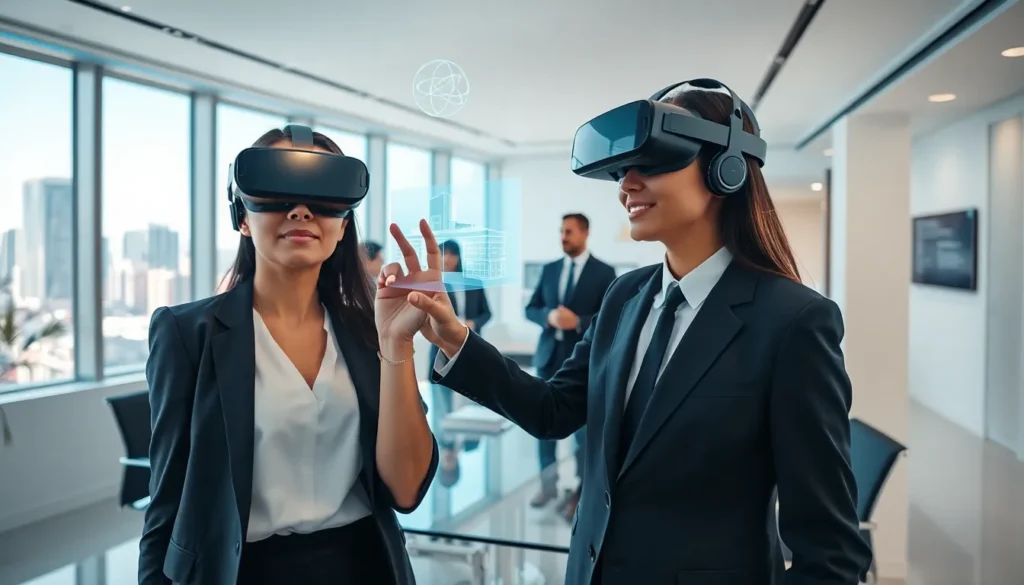
Businesses have moved past pilot programs. Virtual reality trends 2026 show enterprise adoption hitting stride, with measurable ROI driving expansion.
Training applications lead the way. Medical students practice surgeries on virtual patients. Factory workers learn machinery operation without safety risks. Retail employees rehearse customer scenarios. Studies consistently show VR training improves retention rates by 40-60% compared to traditional methods.
Remote collaboration tools have matured significantly. Design teams review 3D models at true scale. Architects walk clients through buildings before construction begins. Engineers manipulate complex assemblies in shared virtual workspaces. These applications save travel costs and accelerate decision-making.
Virtual reality also transforms hiring and onboarding. Candidates experience workplace environments during interviews. New employees complete orientation programs that simulate real scenarios they’ll encounter. Companies report faster time-to-productivity and reduced early turnover.
Sales and marketing teams use VR to showcase products that are difficult to demonstrate physically. Heavy machinery, architectural projects, and complex systems become accessible to prospects anywhere in the world.
Data visualization takes new forms in enterprise VR. Analysts step inside datasets, spotting patterns invisible on flat screens. Financial models, supply chain networks, and customer behavior maps become spatial experiences that reveal insights faster than traditional dashboards.
Health, Wellness, and Therapy Uses
Healthcare represents one of the most promising frontiers for virtual reality trends 2026. Applications span mental health treatment, physical rehabilitation, and wellness practices.
Exposure therapy for anxiety disorders and phobias has gained clinical acceptance. Patients confront fears in controlled virtual environments, heights, public speaking, crowded spaces, with therapist guidance. Insurance companies increasingly cover VR-assisted treatment, recognizing its effectiveness.
Pain management applications show strong results. Burn victims, chronic pain sufferers, and post-surgical patients report reduced discomfort during VR distraction therapy. Hospitals have integrated these programs into standard care protocols.
Physical rehabilitation uses VR to make repetitive exercises engaging. Stroke recovery, joint replacement rehab, and balance training become games rather than tedious routines. Patient compliance improves, and therapists can track progress through detailed motion data.
Mindfulness and meditation apps have grown sophisticated. Users access guided sessions in calming virtual environments, forests, beaches, mountain peaks. Biometric feedback adjusts the experience based on heart rate and breathing patterns.
Senior care facilities deploy VR to combat isolation and cognitive decline. Residents travel virtually to childhood neighborhoods, famous landmarks, and family gatherings. The emotional benefits translate to improved mood and engagement.
Fitness applications continue expanding. VR workouts disguise intense exercise as gameplay. Users burn calories while boxing virtual opponents, dancing to rhythm games, or exploring adventure scenarios that require physical movement.